













“Here, right next to the chapel itself, stands an old spreading birch tree which, as something sacred, is an object of reverent veneration. In its bark, at some height above the ground, a cobblestone has grown in so deeply that it is now barely visible. According to legend, this is the very stone that was thrown by the enraged, lustful devil at Friday, who was fleeing from his temptations and saving herself in the tree. And next to the tree, at the very root, there is another stone... This is the stone on which Friday pressed her foot in order to jump quickly onto the tree, and there she left a deep imprint of her foot. The water that collects here is regarded by the people as the tears of the righteous woman, weeping for human sins.” “Legend says that Paraskeva was pursued, according to some versions, by a leshy, according to others by the devil, and according to still others by a shepherd. The stone thrown after her became stuck in the birch, while she herself, jumping onto the tree, left a deep imprint in the stone. In memory of this, a long shepherd’s whip used to hang on the birch.”
“One day on Elijah’s Friday a local shepherd saw a little girl in old-fashioned clothing on the birch tree, looking at him through the branches. To all the shepherd’s invitations to come down, the girl responded with silence. Then the shepherd tried to drive her down with a whip, and then to knock her down with stones. But the whip and the stones stuck to the tree without touching the girl. The shepherd became frightened and understood that ‘this was no simple matter,’ prayed, climbed the birch, carefully took the girl down, placed her in a bag, and carried her to the local priest. On the way the girl disappeared from the bag. The priest gathered people, and they went with banners and prayerful singing to the birch where the shepherd had seen the girl, and there everyone saw the stones and the whip stuck to the tree. Under the tree stood a wooden icon of Paraskeva Friday — an exact copy of the little girl who had appeared to the shepherd. The icon was placed in the local Church of St. Nicholas the Wonderworker. At the place where the icon was found, not far from the birch, a stone with hollows in the form of a child’s foot was found. A wooden chapel was built here, and soon a spring opened, which was also interpreted as a good sign.” “Near the chapel stood a birch, near the stone there was a shepherd. He saw the icon and wanted to strike it with his whip. But the whip remained on the birch and grew into it. An imprint remained on the stone, as though a foot had stepped on it. There is water in this footprint. There people wash: one the face, another the hand, a third something else, whatever hurts.”
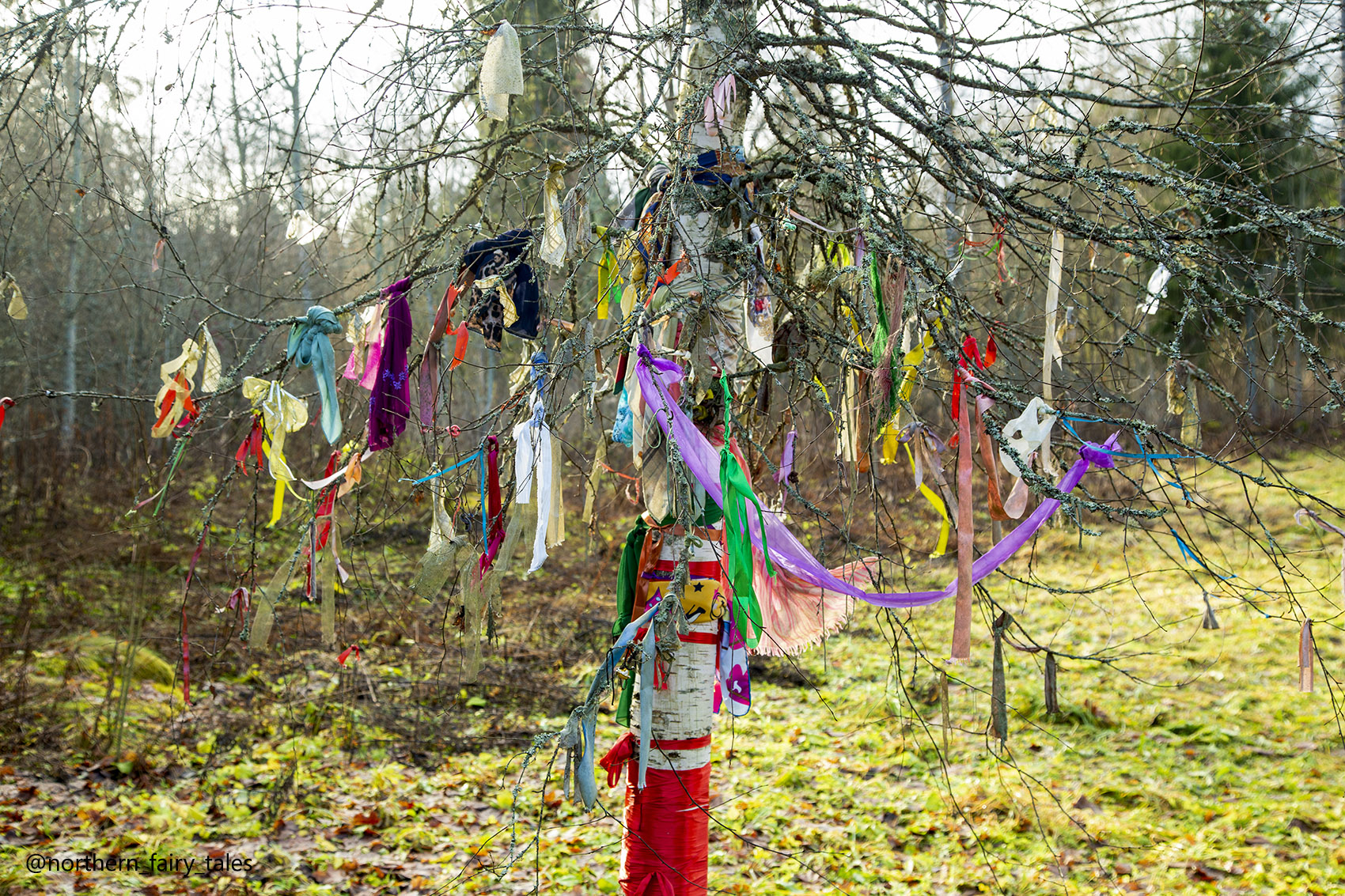
The new "holy birch"
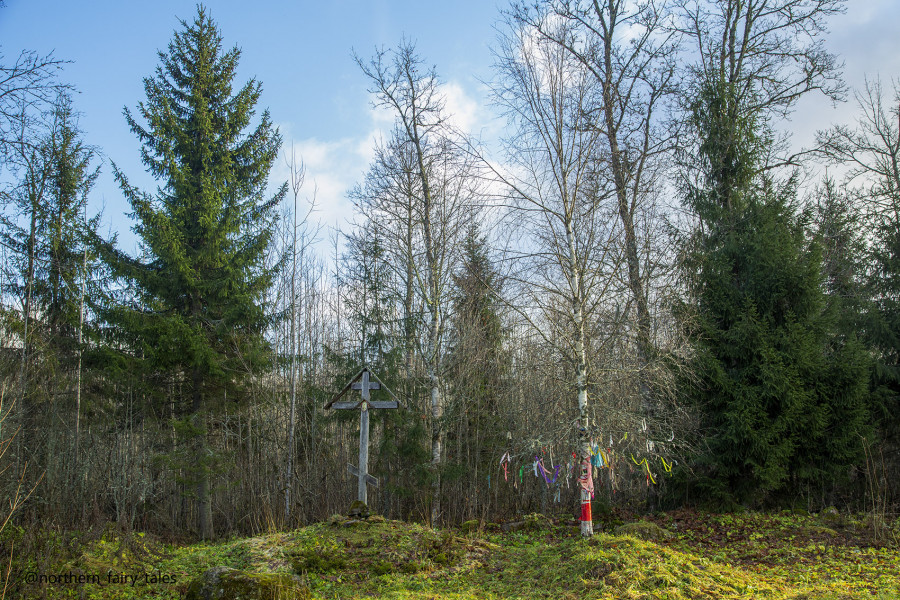
All these stories are interpretations of one event which, according to legend, took place in the location you can see in these photographs, very close to the village of Ilyeshi, not far from St. Petersburg, on Elijah’s Friday — a non-canonical feast which was very popular and was celebrated on the Friday closest to the day of Saint Elijah. This gave rise to what is called the Ilyeshi cult — the appearance in this place of Saint Paraskeva Friday or, as can be seen in one of the legends, of an icon bearing her image. The only witness to the appearance was a certain devilish shepherd who pursued the saint, as a result of which a sacred complex appeared: a holy birch standing behind a wooden fence, with a stone and a whip grown into it; a stone with the imprint of the saint’s foot; a spring, later turned into a well; and a chapel, first wooden and then solid brick, with the carved “found” image of Paraskeva. By the beginning of the 20th century, such a popular and powerful sacred center had formed here that every year on Elijah’s Friday thousands of pilgrims gathered here; in some years at the end of the 19th century the number of worshippers reached 20,000 people — a simply fantastic figure, an absolute rarity for rural shrines. Many believers arrived from distant places by train to the Moloskovitsy station, some came on horseback, some on foot. Unlike many similar local cults, the veneration of the local Paraskeva Friday was known even beyond the borders of Saint Petersburg Province. “The Ilyeshi shrine was venerated not only by the Russian inhabitants of this area, but also by Estonians, Votes, and Izhorians.” The highlight of the feast was undoubtedly the carved icon of Paraskeva, which on this day was carried out on a litter from her house-chapel, and after the solemn service was returned with a crowded religious procession.
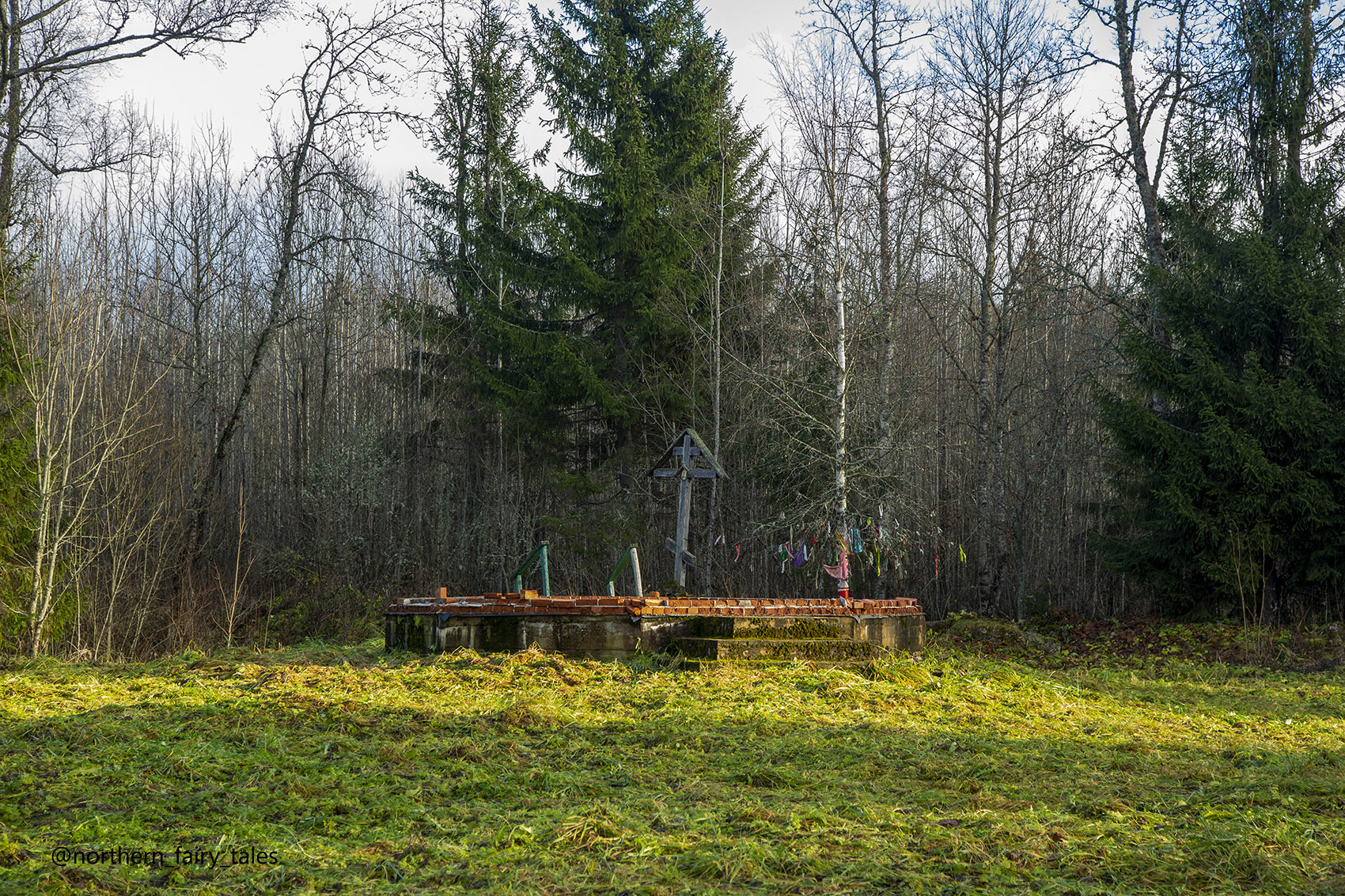
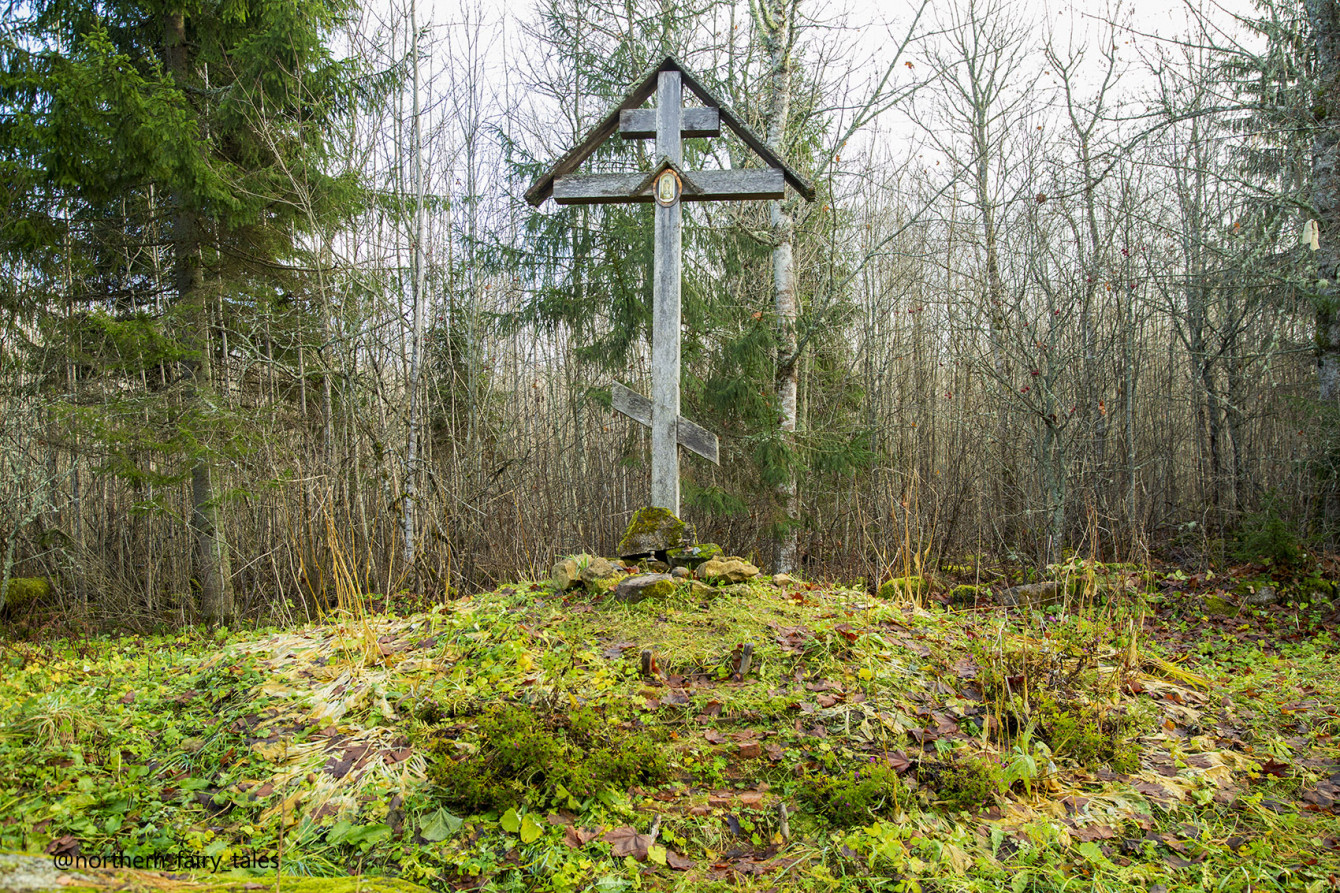
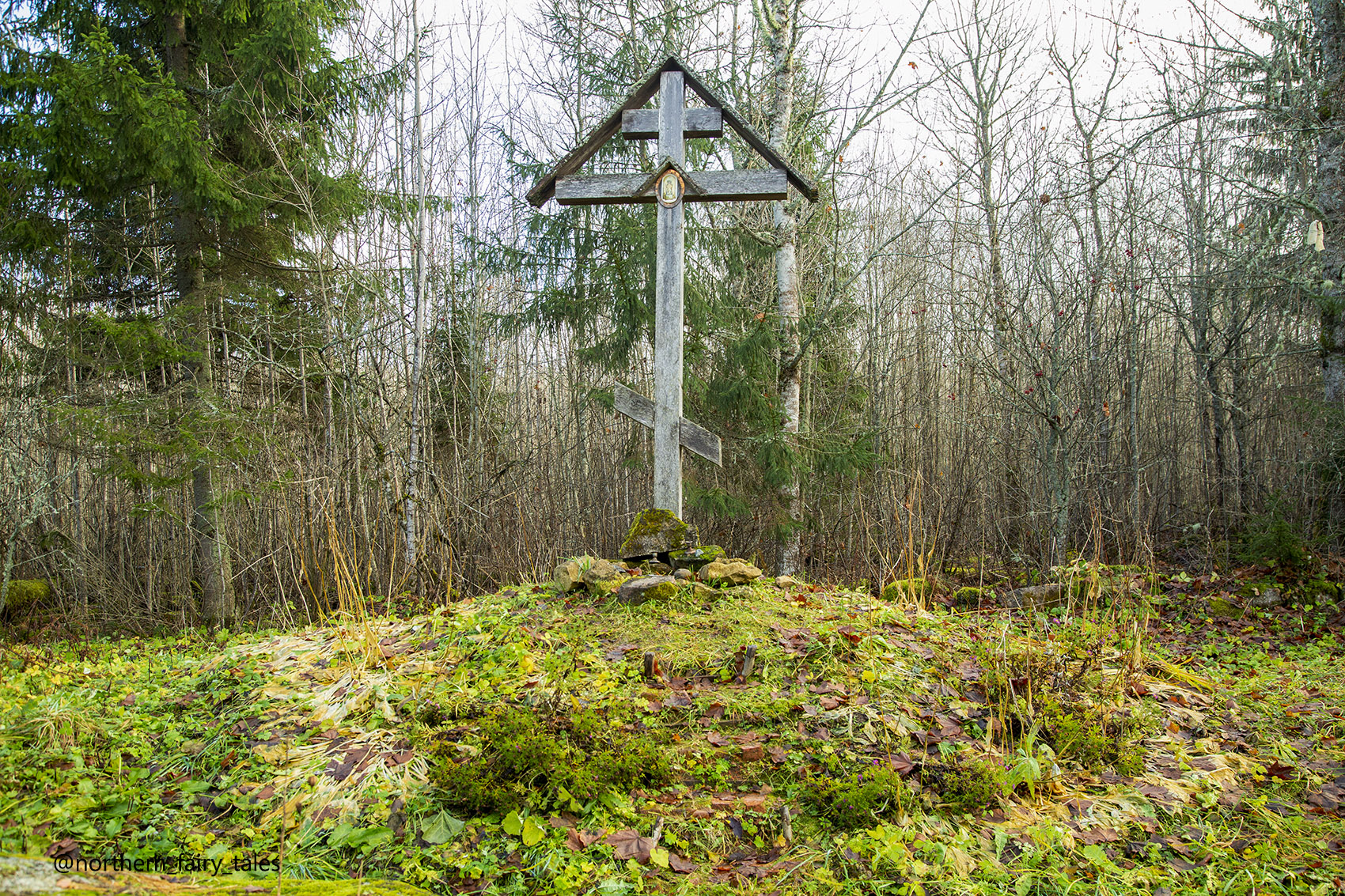
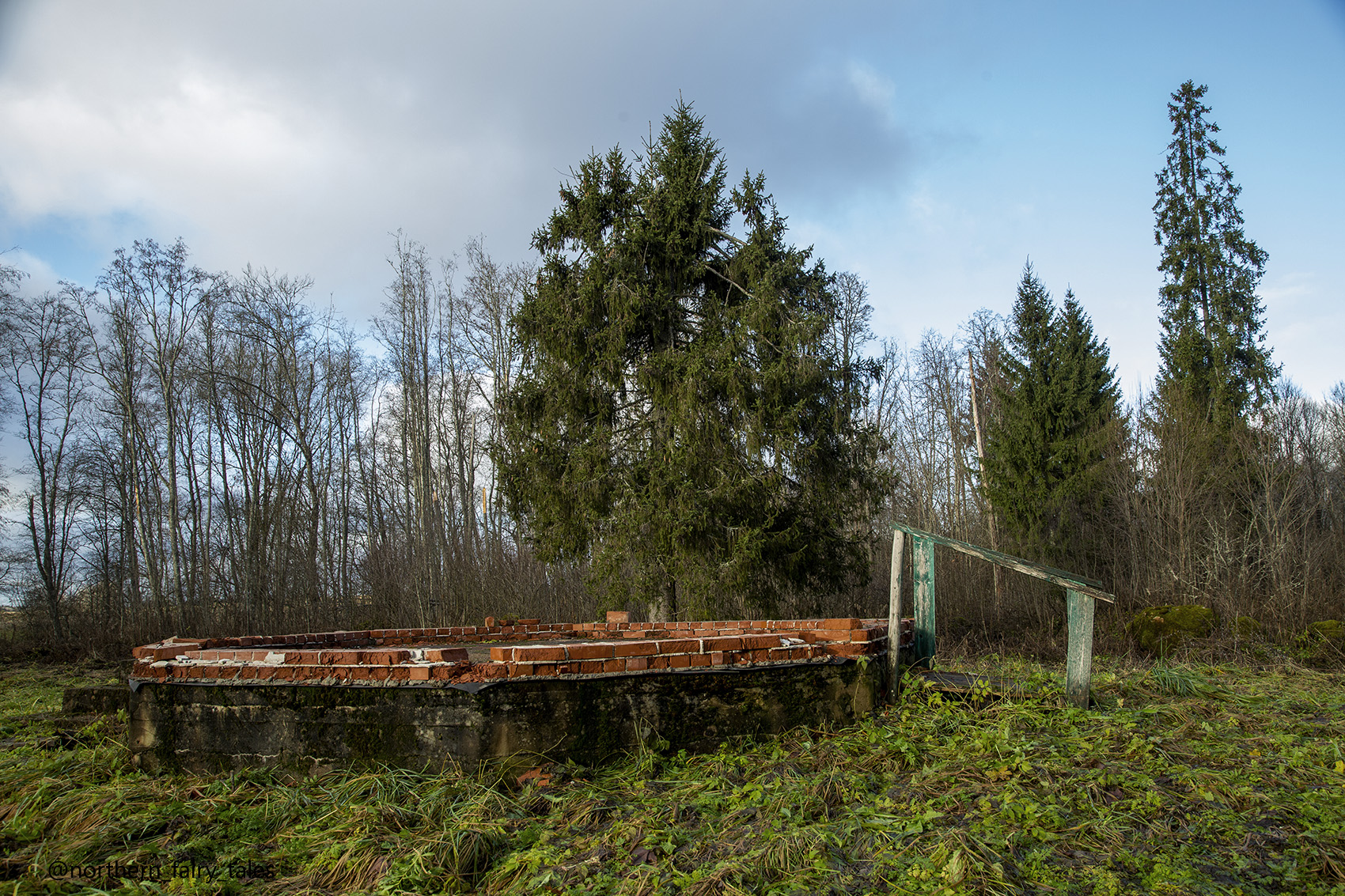
the foundation for the chapel, a cross and a birch tree
The ethnographer S. Maksimov, who witnessed this, described the action as follows: “Above the heads of the kneeling worshippers, bowed downward, there passes, lifted high on a litter, a heavy shrine-case with a wooden image of Friday.” The pilgrims, and especially the women pilgrims, did not remain idle at this time, but tried ritually to crawl under the holy litter or to have it carried over them; it was believed that this could help a girl get married. A local priest described the shrine as follows: “This icon is carved from wood; its height is one arshin. In the right hand of the saint there had formerly been an изображение of a scroll; in the left, a cross. The carving of the icon is old and not especially skillful. Before a riza was made for the icon, it was dressed in a garment like a sarafan, made of various fabrics donated by worshippers. The icon is considered wonderworking, a revealed one; they say that it appeared in a field one and a half versts from the church, there where there is now an old wooden chapel to which a religious procession is usually made. The zealous offerings to the icon belong chiefly to the simple peasant folk and consist of belts, ribbons, towels, pieces of linen, and the like. Sometimes silver images of hands, feet, hearts, and so on are hung on the icon in memory of miraculous healings.” Thus one may speak of votive offerings practiced by the worshippers. The riza worn by Paraskeva was made of gilded silver with three large precious stones in 1853 by a famous Saint Petersburg jeweler, paid for by the merchant Vetoshkin as a sign of his healing from a severe illness of the legs.

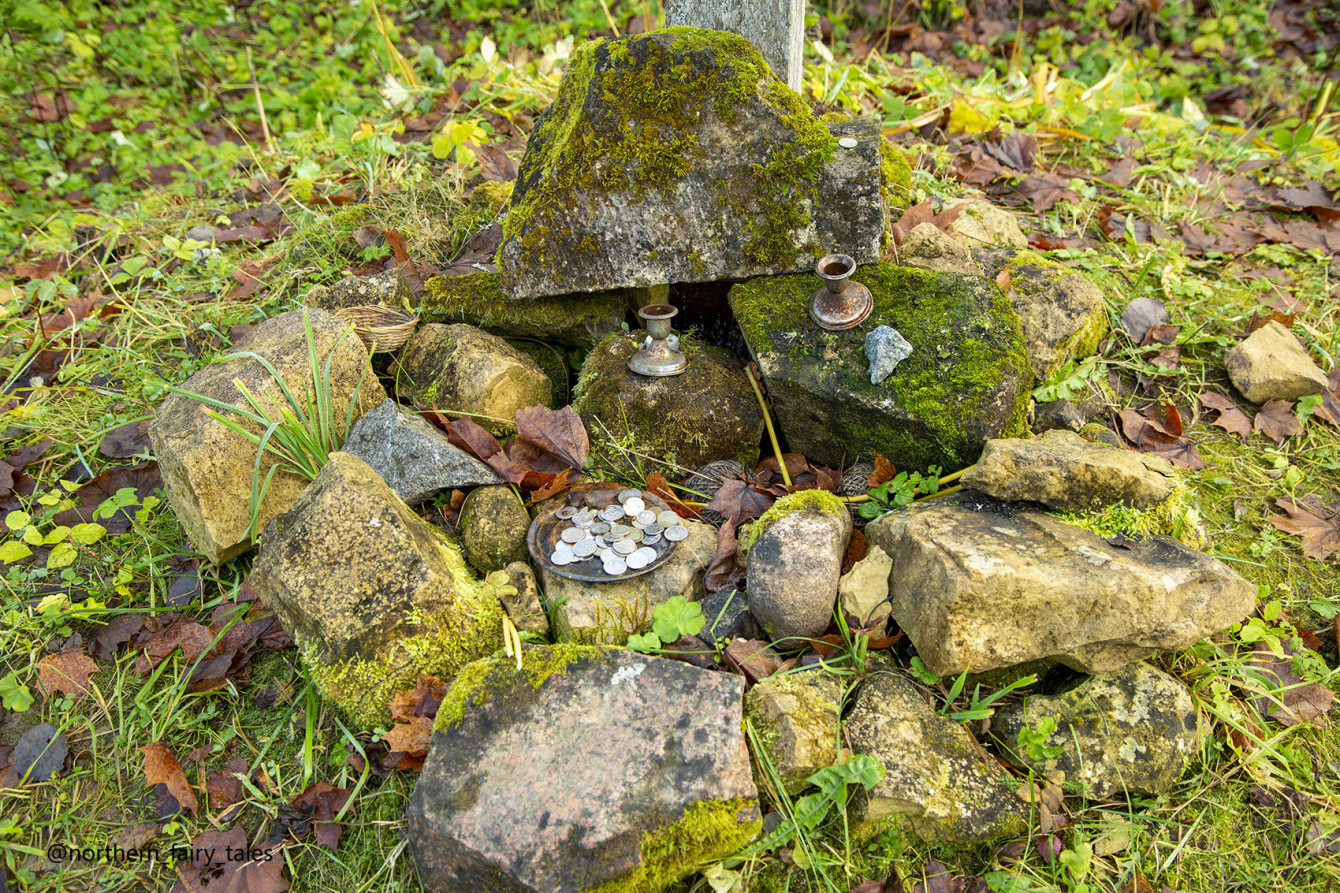
stones at the foot of the cross, candles and coins left by pilgrims
In general, wooden statues of Paraskeva Friday (and not only her; there were also widespread images, for example, of the Russian god-like figure Nikolas the Wonderworker and certain other saints) appear in Rus’ as early as the 15th century, quite possibly as a result of Western cultural influence, and spread especially widely from the middle of the 16th century in the North and Northwest. Very often such sculptural icons were placed next to sacred stones, springs, wells, in groves, at crossroads; they served as signs emphasizing the sacredness of such places. Most often such statues, like the one from Ilyeshi, were considered “found” or “revealed,” that is, as though appearing directly from the other world. “A painted wooden statue of Friday, sometimes in the form of a woman in eastern dress, and sometimes in the form of a simple peasant woman in a poneva and bast shoes”: this is how eyewitnesses described similar works of art. Such statues “were placed in churches in special cabinets, and the people prayed before this idol”; most often the prayers were accompanied by offerings: “The bottoms of the wells glimmer like fish scales with silver grivenniks and five-kopeck pieces... various products of women’s handiwork are handed over or simply thrown there, often with a loud declaration of the direct purpose of the offering: sewn linen in the form of shirts, towels for decorating the wreath and the face, combed flax tow or spun ready threads, as well as wool (sheep’s wool, our note). ‘For the saint’s stockings!’ ‘For Mother Friday’s apron!’ the women cry in such cases.” It is true that most such idols were destroyed after the decree of the Holy Synod of 1722, which required such images to be banned in churches because of their “imperfection” and “ugliness.” Most likely, the true reason for the ban lay in the struggle against popular “superstitions.” All the more so, the Ilyeshi image, which escaped destruction and became in effect unique, attracted the attention of broad masses of believers.

The large-scale celebrations of Elijah’s Friday in Ilyeshi lasted several days and were accompanied by fair festivities. At the holy place people were treated for eye diseases by washing with the water from Paraskeva’s footprint in the stone; they gathered healing sand and pebbles, bark from trees from the holy place; they applied moss to sore spots; they offered money; they slaughtered rams; some healed livestock there; some crawled around the chapel on their knees; from some demons were cast out; some left notes for health and for the repose of the dead in and around the chapel; girls prayed for marriage.
The archaic character of these festive practices shocked progressive contemporaries. A Saint Petersburg physician and Doctor of Medicine described the Ilyeshi sacred action at the end of the 19th century as follows: “What I witnessed somewhat resembles the descriptions of travelers in the East Indies of native festivals in honor of various gods and goddesses. On flat boulders, only a few steps from the clergy, who prudently notice nothing, there takes place the casting out of demons and the healing of many illnesses. And that by smearing the eyes and lips with dirty hands using water from puddles on the stones, syphilis and purulent inflammation of the eyes may be transmitted — these are unquestionable things. Money is left on the stones; in one of the stones there is a deeper hole, with the capacity of several bottles; water is also poured there, and, scooping it up with the hands, people wash their faces. The most wonderworking stone is considered the largest of them, on which the casting out of demons takes place. The demons are cast out by healers, who undress hysterical women to their shift and lay them on the wet stone, remove their stockings and shoes, squeeze the fingers of their hands and feet, and ask: ‘Who spoiled you? Will the Devil soon come out of you?’ The casting out continues for about an hour. To hasten the miracle they give them wooden oil to drink and incense to eat. If the woman, following the healer, reads ‘Let God arise,’ she is considered healed. Next to the chapel stands a wonderworking birch whose bark has all been gnawed away by the teeth of worshippers for healing toothache.” In turn, the Ilyeshi mystery also drew criticism from representatives of the official Synodal cult, who wished “to give a Christian character to a festival far removed from Christianity.” One may fully agree with this statement — in the Ilyeshi cult there is in fact very little that is properly Christian, apart from some symbolism and the Christian name Paraskeva, although this applies to the entire popular image of this saint.

In fact, our northern figure Paraskeva Friday has little in common with the ancient martyr Paraskeva of Iconium (Paraskeva in Greek means Friday, preparation for the Sabbath), who lived in the Roman Empire in the Asia Minor city of Iconium in the time of the persecutor of Christians, Emperor Diocletian. Having chosen the path of active asceticism and virginity, she was subjected to tortures and beheaded. Nor does the popular Friday correspond to another personage — Paraskeva of Serbia, a Balkan ascetic of the 11th century who spent most of her life in the Jordanian desert.

on the way to the sanctuary
The pre-revolutionary researcher Maksimov wrote about this deity as follows: “One thing is beyond doubt: that this is not that holy martyr of the Greek Church who suffered for Christ under Diocletian in Iconium in the year 282, whom the Orthodox Church commemorates on October 28 under the name of Paraskeva, called Friday, but another, particular, its own, and still to this day existing alive and acting.” The “superstitions” connected with Paraskeva were condemned already in the 16th century at the Stoglav Council: “And through the churchyards and through the villages false prophets go about, men and women, girls and old women, naked and barefoot, with their long hair let loose, shaking and writhing. And they say that holy Friday and holy Anastasia appear to them and command them to transmit canons and commandments to Christians. And they command the peasants on Wednesday and Friday not to do handwork, and the women not to spin, nor wash clothes, nor light the stove.”

Indeed, on Friday and on October 28 (the church feast day of the saint) there existed a number of prohibitions on women’s work: spinning, sewing, washing linen, bleaching cloth, combing hair. On Russian folk soil, as some researchers believe, the image of the Christian saint was superimposed upon the images of pre-Christian mystical figures such as Makosh/Mokosh — the ancient Slavic mistress of waters, fertility, and spinning, connected with the image of Mother Damp Earth. The Russians called Friday “the earthly and watery mother.” It is quite possible that the cult of Paraskeva merged among the Eastern Slavs with the personified fifth day of the week — Friday — about which not much information survives, and also with folk ideas about the Mother of God.

Beyond this copse is a holy glade
But in the popular image of Friday there are not only pre-Christian features of a local deity, a genius loci, patroness of springs and wells; in many respects she also approaches representatives of the so-called unclean force. Judge for yourselves: “Her appearance in folk notions is far from her canonical iconography, where she is depicted as a strict, ascetic-looking woman in a red omophorion. Folk imagination endows her with demonic traits: great height, long loose hair, large breasts that she throws over her shoulders, and so on, which brings her closer to female mythological figures such as Dolya, Death, and the rusalka.” The closeness of Paraskeva Friday to the rusalka is also noted by D. Zelenin in his Sketches of Russian Mythology: “The belonging of Friday to the rusalki explains to us why Friday is celebrated precisely on the ninth and tenth Fridays after Easter (this is the period of the rusalka festivals) and why it is celebrated by water, that is to say: why Friday is considered the patroness of water — this is so natural for a rusalka,” “...‘whoever fasts on Fridays will never have fever’ — this belief, widespread among the people, we interpret thus: whoever honors the rusalka Friday (to whom, as is known, the fifth day of the week is dedicated), to that person the fever-rusalki will also be merciful.” Researchers also note Friday’s connection with death. There is a legend in which Friday, after sharing a meal with a peasant, grants him three hundred years of life and a rich wife, but in the end brings death with her and sends the unfortunate man to Hell for his ingratitude. In favor of her connection with death is also the fact that “places for Friday churches are allotted in cemeteries and ... according to present customs, drinking in memory of deceased parents is done especially on Elijah’s Friday in addition to the other memorial and requiem days.” On Elijah’s Friday in former times the bodies of those who had died unnatural deaths, accumulated over the year in skudel’nitsy and bozhedomki (special houses for the corpses of the murdered, the frozen, suicides, and so on), were finally committed to the earth.

a few archives: prayers near the Ilyesh Chapel on Ilyinsky Friday
As a true representative of demonology, Paraskeva Friday oversees the observance of Friday taboos and mercilessly punishes their violation, while at the same time complaining that those who do not honor her day stab her with spindles, clog her eyes with chaff, and so forth. As punishment for this she could send illnesses — twist fingers, place shooting pains and aches in the back, take away sight; refuse help in childbirth, turn someone into a frog, or simply appear in the form of a young woman and, after flaying the skin from someone alive, hang it on the instrument of the crime — the loom. On the other hand, her image is ambivalent — she is also a beneficent principle, as often happens in folk mythology. In Russian tradition Paraskeva Friday is the patroness of marriages; people prayed to her for a bridegroom, she was a healer of illnesses, including those developed as a result of sorcery, and people turned to her for deliverance from possession and for the preservation of livestock; rites and prayers connected with these troubles also took place during the Ilyeshi mysteries. Such was our mother Paraskeva Friday — kind, but strict!
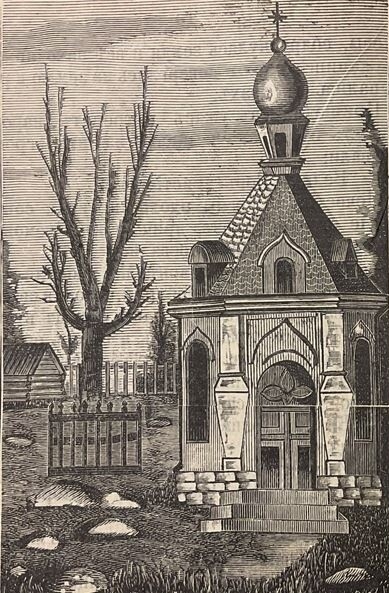
An old engraving in which you can see a chapel, a birch tree and a stone
Returning to the Ilyeshi cult, one cannot pass over the figure of the shepherd either, for it is not accidental in this legend and is directly connected with the situation of the emergence of this sacred place. The anthropologist A. Panchenko, who devoted much attention to Ilyeshi in his book Studies in the Field of Folk Orthodoxy, notes: “the shepherd’s secret knowledge and his closeness to the world of the forest make him more prepared for contact with a representative of the sacred sphere. On the other hand, the shepherd is quite suitable for the role of ‘antagonist’: he is not an ordinary member of the community; his meeting with a woman can easily produce a situation conflicting from the point of view of magical norms of behavior; and finally, the shepherd still appears as a being, to a certain degree unclean.” Not recognizing the saint in the girl/woman who appeared, the shepherd tries to behave toward her as toward an ordinary creature — “the shepherd was not supposed to be seen when the cow was being led out, otherwise he might strike its legs with a switch”; “however, these rules are not applicable to a sacred being: the whip with which the shepherd tries to strike the saint turns to stone; thus the presence of sacred power is demonstrated.” Additional testimonies of hierophany were the footprint in the stone — the “well of the Martyr Paraskeva” (according to some data there were two stones — one precisely the stone with the footprint, the second, larger one with a deep hollow from which worshippers took the healing water that had collected there; it was this stone that was called the “well”) — and the stone thrown by the shepherd, grown into the birch. There is even a hypothesis that the Ilyeshi cult contains a reminiscence of the “basic Indo-European myth,” in particular the plot of the Thunderer pursuing his wife.
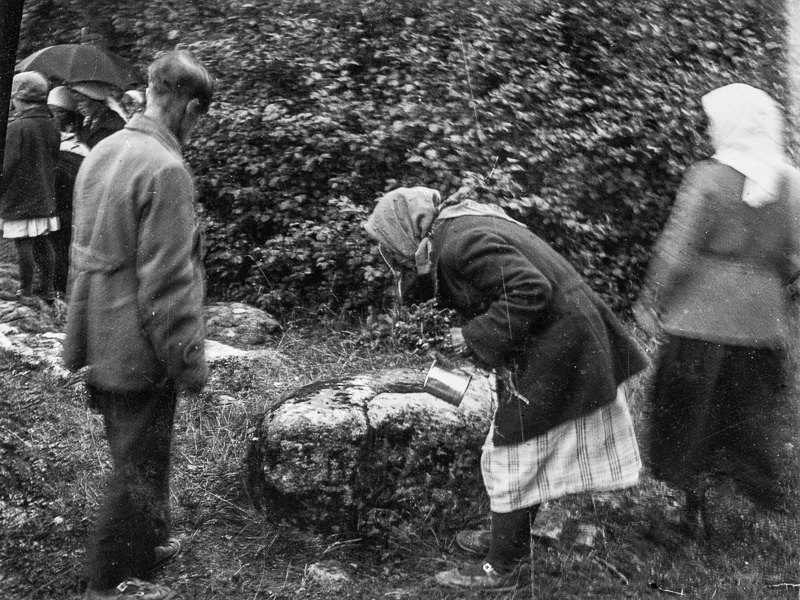
Pilgrims take holy water from a well in a stone
In the 20th century the decline of this sacred place began. Already at the beginning of the century the holy birch stood completely dried out behind the chapel fence; by the 1930s not even a stump remained of it. After the Bolsheviks came to power, the number of pilgrims decreased, though it still remained considerable. By that time the spring had also disappeared. The Soviet ethnographer N. Matorin testified that even in 1929 believers were still taking water from the “well of Paraskeva” and washing their eyes with it; at the same feast they led a sick horse around the chapel three times and dug the ground where the birch had stood in search of its healing roots. In 1935 the bell was thrown down from St. Nicholas Church in the village itself, and in 1937 it ceased functioning, although the carved icon-statue was kept there. The chapel, however, remained open; people continued to go there on feast days, girls continued to ask for bridegrooms, and schoolchildren, going to examinations, scratched on the walls: “Great Martyr Paraskeva, help me pass the exams.” During the war years wives left requests in the chapel for the return of their husbands alive. The decisive moment for the Ilyeshi cult came in 1961. The beginning of the 1960s was marked by a new offensive against the religious and mystical aspects of social life. But whereas in the 1920s and 1930s of the 20th century destruction was directed first of all against large objects — churches and monasteries belonging to various church structures — in Khrushchev’s time the state turned its attention to the sacred cults of ordinary people: chapels, springs, little wells, stones, trees, and the like. Local mythology says that the chapel was blown up on the personal order of the General Secretary, and soldiers were brought in for this purpose, because the local residents refused to destroy the chapel. The ruins and the holy stone (or stones?) were pushed by bulldozers into a prepared pit. Some local residents believe that the stone was stolen. The place itself became overgrown with nettles, while the statue of Paraskeva was transferred to a museum. Thus this shrine, famous throughout the whole Northwest, perished.
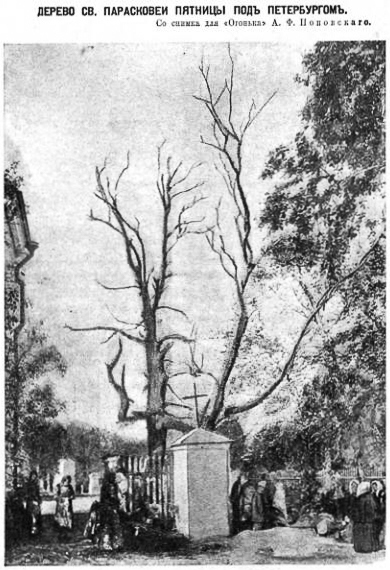
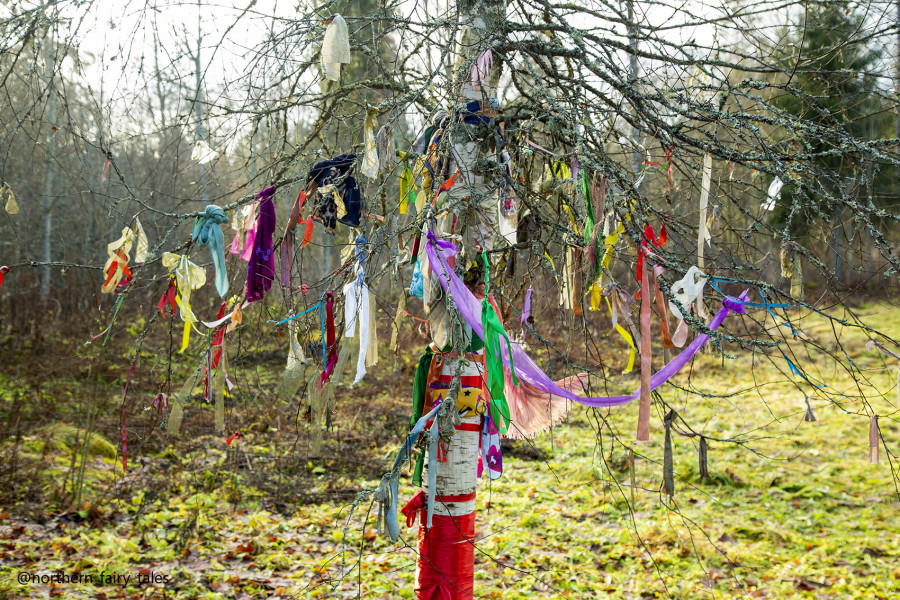
the holy birch tree behind the fence
Beginning from the late 1980s, the “revival” of the cult place began. First the tradition of the annual religious procession from St. Nicholas Church in Ilyeshi to the place of the epiphany was restored, first with a copy of the icon and later with the original, now kept in the Alexander Nevsky Lavra. A foundation was laid, a cross was installed, and at its foot stones are piled up on which candles are burned. Believers chose a young birch standing forlornly in the glade and decorate it with colored ribbons, thus trying to return to mythological reality. Earlier a large stone had also been chosen, on which a cross was laid out with bricks from the old chapel, but by the autumn of 2024 this installation was no longer there. We visited this place twice and drew some conclusions of our own: only some insignificant fragments and ruins remain here, which modern people are trying to piece together. Is this possible? Of course, there is the well-known saying, “a holy place is never empty.” But on the other hand, we sometimes like to play at cross-cultural comparisons, and here there comes to mind a very interesting book on Jewish folk beliefs by M. Badhen, Jewish Demonology, in which the author plainly states that spirits and demons need a body, no matter what that body may be — a structure, a stone, a tree, or a landscape. If that body is destroyed, the spirit can no longer exist, at least not in that place. There is something similar in our folklore as well; for example, the Leshy (Leshy is the spirit-master of the forest in Slavic mythology) cannot endure fire, because it may threaten his home — the forest — without which he will perish. Thus one may state that the body of this place has been completely destroyed: there is no tree with the signs of the other world, no stones, no spring, no chapel, and the icon has been removed and taken away. If we turn to another image — a door between worlds — then as a result of the destruction of the Ilyeshi cult place, that door, in our view, was not only nailed shut from this side by complete devastation, which was the aim of the Bolshevik actions, but also propped with a good log from the other side, from the transcendent side. Of course, in such subtle matters it is difficult to be certain of anything, so we will simply leave believers to reconstruct their beliefs, and perhaps someone will still knock from the other side at the closed door, or some message will come from the other world.
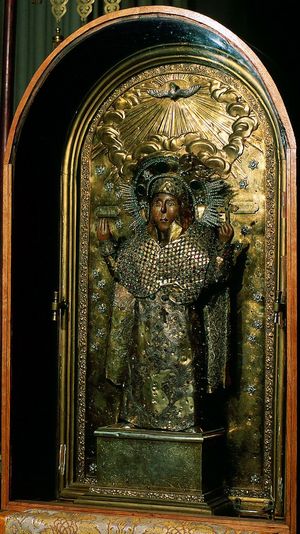
The carved icon of Paraskeva Friday, allegedly found in Ilyeshy