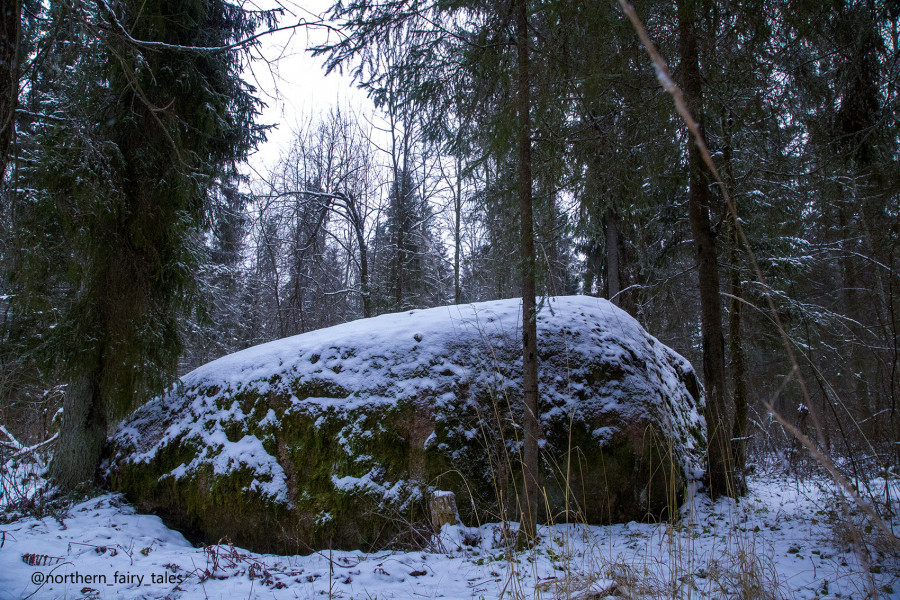
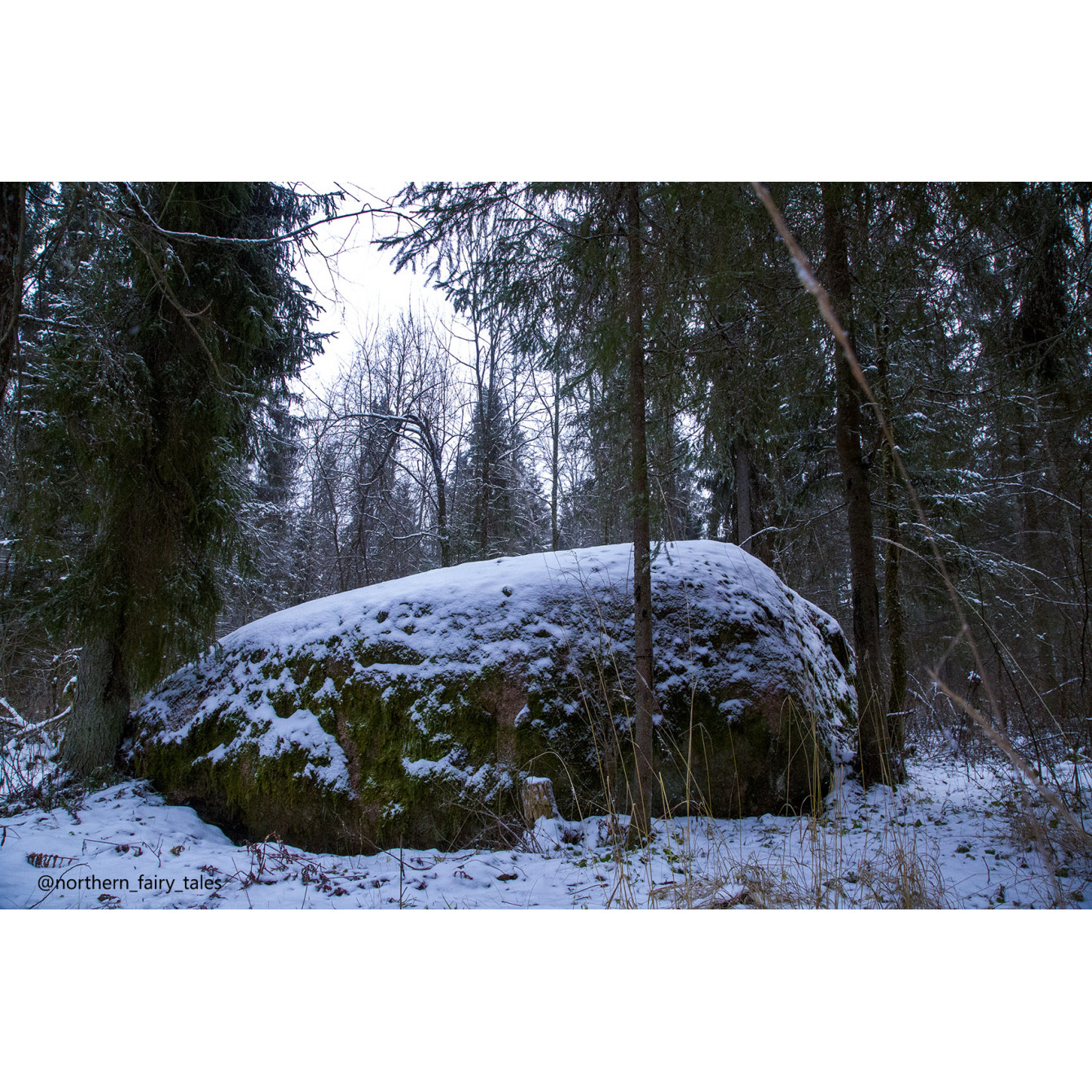
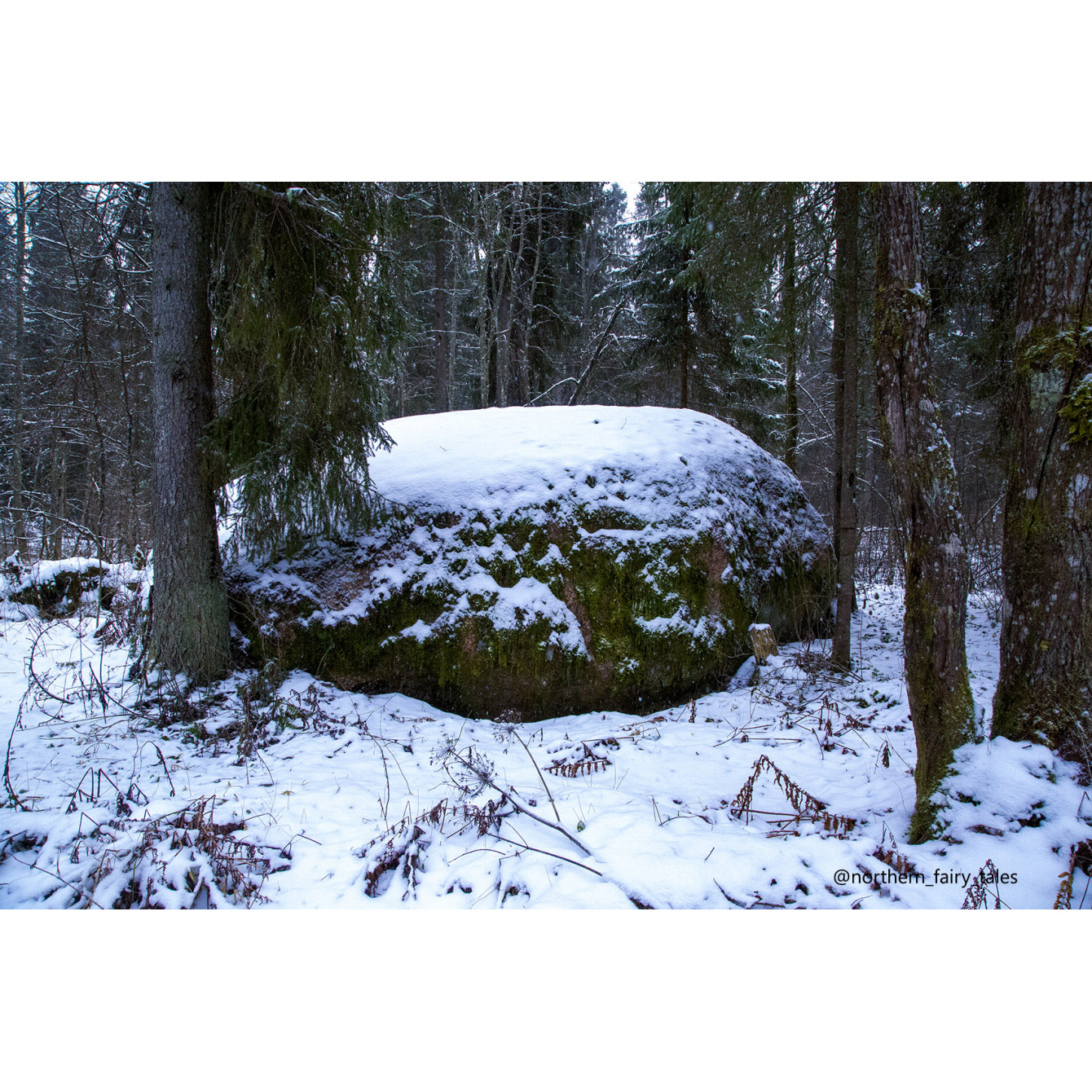
Another great sacred boulder of the North, dragged here by the mighty Ice Age, lies hidden in the remnants of the taiga just 30 kilometers from St. Petersburg.
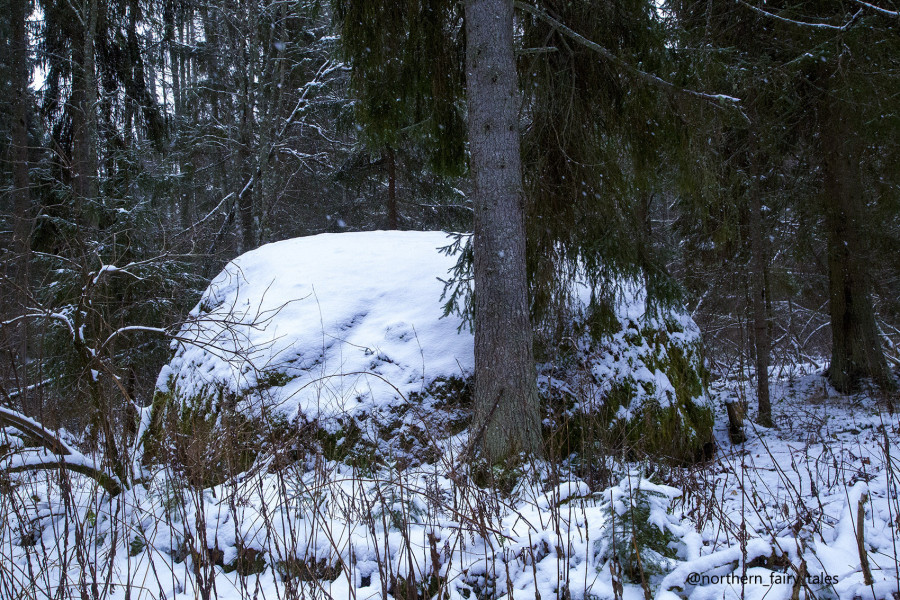
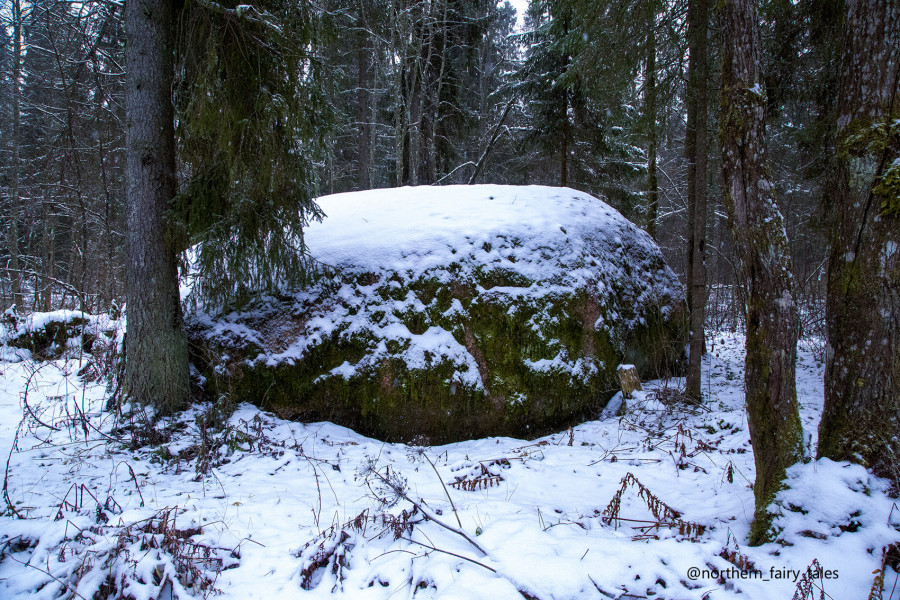
Unlike its more famous stone neighbor—the Church or Demon Stone—not much is known about this one. It has no haunting legends attached, and even its name lacks mystery: translated from Finnish, it’s simply "The Big Stone." But the name doesn’t lie—it truly is big: over 3 meters high, 5 meters wide, and more than 7 meters long.
Unlike the Church Stone, once notoriously hard to find in the forest (we ourselves once wandered for hours chasing illusions—“There it is!”—only to discover it was an uprooted tree or some trick of the woods), this boulder sits right beside a forest road. It’s impossible to miss.
There are markings on the stone—faint outlines of a horseshoe and a small cross—suggesting it once served as a boundary marker in medieval times. Unfortunately, deep snow during our visit kept us from photographing these symbols.
The few locals we encountered knew nothing about the boulder—unsurprising, as most residents now are unenthusiastic summer homeowners.
The only real information came from a local historian’s book: "When someone got lost in the forest, they didn’t look for the village—they looked for the stone. During the Second World War, a mass was once held at the boulder, attended by the entire village. According to one account, this was an old tradition—performed in times of loss or great misfortune."
This hints at a now-forgotten legend—perhaps of a supernatural being once believed to appear at the stone, to whom the local Finnic people turned in times of need. The fact that a ritual mass (or something like it) was held here in moments of crisis suggests the Suurkivi was seen as a forest chapel of sorts—a spiritual meeting point between villagers and the spirits of the taiga.
Centuries ago, in the dense forests of the Russian North, when someone disappeared, it was the village sorcerer who would come to a place like this, demanding forest spirits release their captive. In this sense, the boulder functioned as a sacred space, a “gathering point” for the half-believers and spirit-world mediators of the taiga.
And who knows—if you’re lucky, you might still meet one of those forest spirits today.
Comments
There are no comments for this article yet. Be the first to comment!